
Health insights
ACL Injury: Symptoms, Tests and Reconstruction Surgery
How to recognise an ACL tear, how it is tested and scanned, when ACL reconstruction surgery is needed and what recovery looks like.
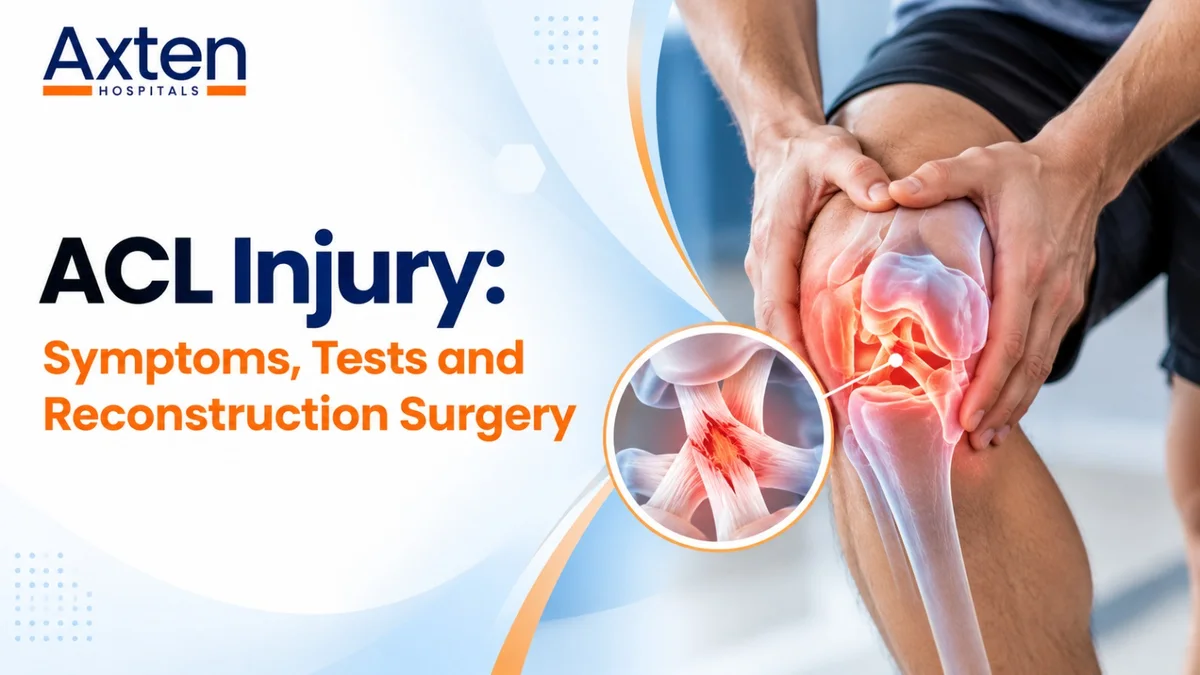
An ACL injury often happens in a second: a sudden twist while playing football, cricket or badminton, a bad landing from a jump, or a fall. Many people hear or feel a "pop". The knee then swells and doesn't feel safe. A torn ACL doesn't heal on its own, but with the right care, most people return to normal life, and many return to sport.
What is the ACL?
The anterior cruciate ligament (ACL) is a strong band inside the knee that connects the thigh bone to the shin bone. It stops the shin from sliding forward and keeps the knee steady when you twist or change direction. A tear can be partial or complete.
How does an ACL injury happen?
-
Sudden stopping, cutting or pivoting
-
Landing awkwardly from a jump
-
A direct blow to the side of the knee, as in a tackle
-
A twisting fall, such as in skiing or kabaddi
Most ACL tears happen without contact. They are more common in women, and in sports with sudden direction changes.
Symptoms of an ACL injury
-
A pop or snap at the time of injury
-
Pain, often severe at first
-
Swelling within a few hours
-
A feeling that the knee is loose or "gives way", especially on stairs or when turning
-
Trouble bending or straightening the knee fully
-
Difficulty walking, or putting weight on the leg
The pain may ease after a few days, but the instability remains. Many people think the knee has healed and go back to sport, and then injure it again.
How is an ACL tear diagnosed?
Examination
The doctor moves the knee in specific ways. The Lachman test, the anterior drawer test and the pivot-shift test check whether the shin slides forward too much.
Scans
-
X-ray: doesn't show the ligament but rules out a broken bone
-
MRI: the best scan to confirm an ACL tear and to check the meniscus (cartilage) and other ligaments, which are often hurt at the same time
Get help now: Get the knee checked the same day or next day if there is a pop followed by swelling, you can't bear weight, the knee is locked and can't straighten, or the leg is numb, pale or cold. A knee dislocation with vessel injury is an emergency.
First aid for a fresh injury
-
Rest, and avoid putting weight on the leg
-
Ice for 15 to 20 minutes every few hours, wrapped in a cloth
-
Compression with a soft bandage
-
Elevate the leg above the heart
-
Use crutches if walking hurts
-
See an orthopaedic doctor soon
Treatment
Without surgery
Physiotherapy to strengthen the muscles around the knee is the choice for some people, especially those who are older, don't play pivoting sports, or have a partial tear. It can work for daily life, but the knee may still feel unstable when twisting.
ACL reconstruction surgery
Surgery is usually advised for people who are active in sports, whose knee gives way in daily life, or who have other ligament or meniscus injuries. The torn ligament is not stitched back. It is replaced with a graft, a piece of tendon taken from your own body, such as the hamstring, the patellar tendon or the quadriceps tendon, and sometimes from a donor.
-
Done by arthroscopy (keyhole), under spinal or general anaesthesia
-
Takes about 1 to 2 hours
-
Hospital stay is usually 1 to 2 days
-
Meniscus injuries, if present, are repaired at the same time
Recovery after ACL surgery
The graft takes time to bond and strengthen, so recovery is gradual, and physiotherapy is the biggest part of it.
| Time | What to expect |
|---|---|
| First 2 weeks | Swelling and pain control, a brace, crutches, and gentle bending and straightening exercises |
| 2 to 6 weeks | Walking without crutches, as advised, and building leg strength |
| 6 weeks to 3 months | Cycling or swimming, as advised, and more strengthening |
| 3 to 6 months | Light jogging, once cleared by your surgeon and physiotherapist |
| 6 to 12 months | Return to sports, after strength and balance tests |
Returning too early is a common reason for a re-tear. Most surgeons advise waiting at least 9 months before pivoting sports.
Risks
Risks include stiffness, pain at the front of the knee, infection, blood clots, graft stretch or re-tear, and rarely nerve injury. Your surgeon will go through these before you decide.
Common questions
Can an ACL tear heal on its own? A complete tear doesn't heal on its own. Strong muscles can help the knee cope, but the ligament stays torn.
Do all ACL tears need surgery? No. Surgery is for those with instability, active lifestyles or other injuries in the knee.
Can I walk with a torn ACL? Many people can, but the knee may give way. Get it checked and avoid sports till then.
Will I get arthritis later? A torn ACL raises the chance of knee arthritis, whether or not surgery is done. Strong muscles and a healthy weight help.
Have questions or want to see a specialist? For appointment and queries, call 8156929292. AXTEN HOSPITALS - HONEST SURGERY, HONEST CARE.