Day-Care Cystoscopy

Day-CareSpecialist surgeons onlyCashless insuranceFree follow-ups
Symptoms evaluated with cystoscopy
Cystoscopy (Day Care) - specialist-led treatment at Axten

Cystoscopy is a diagnostic procedure in which a slim telescope with a camera (cystoscope) is passed through the urethra to examine the inside of the bladder and urinary passage directly. It is the most reliable way to find the cause of blood in urine, recurrent urinary infections, persistent bladder pain, urinary leakage or difficulty passing urine - problems that scans alone often cannot explain.

At Axten Hospitals, cystoscopy is a comfortable day-care procedure: it takes just 15-30 minutes, is done under local, spinal or short general anaesthesia depending on your needs, and you return home the same day. Modern flexible and narrow rigid scopes with high-definition imaging make the examination gentle and thorough.

If a small problem such as a bladder stone, polyp or narrow segment is found, it can often be treated in the same sitting. As always at Axten, you get an honest all-inclusive day-care price, zero surprise billing, cashless insurance support, and a free follow-up to discuss findings and biopsy reports.

Honest all-inclusive price₹18,000 - ₹35,000 (all-inclusive day-care package; add-on treatment priced upfront)See full cost breakdown

Consult for Cystoscopy (Day Care)

Share your details - a care coordinator calls you back within minutes.

Country code +91 selected.

100% confidential · No spam · Honest all-inclusive quotes

Symptoms of Bladder & Urethra Evaluation

  • Blood in the urine, even a single painless episode
  • Recurrent urinary tract infections despite antibiotics
  • Burning or pain while passing urine that keeps returning
  • Frequent or urgent urination disturbing sleep and routine
  • Difficulty starting urination or a weak, interrupted stream
  • Persistent lower abdominal or bladder-area pain
  • Urinary leakage or a feeling of incomplete emptying

Risks of delaying treatment

  • Blood in urine left unexamined may delay diagnosis of an early bladder tumour, which is highly treatable when caught soon
  • Untreated bladder stones keep injuring the bladder wall, causing repeated infection and pain
  • Recurrent unexplained infections can ascend to the kidneys, risking permanent damage
  • A narrowing urethra progressively obstructs urine flow, eventually harming bladder muscle and kidney function

How is bladder & urethra evaluation diagnosed?

Before cystoscopy, your doctor reviews your symptoms and orders urine tests to rule out active infection, along with an ultrasound of the kidneys and bladder. Blood tests assess kidney function and fitness for anaesthesia. If infection is present, it is treated first so the procedure is safe and comfortable.

Cystoscopy itself is the definitive diagnostic step - it visually confirms or rules out bladder stones, tumours, inflammation (cystitis), urethral narrowing and bladder wall abnormalities, and allows targeted biopsies where needed, completing the evaluation that scans and urine tests began.

Benefits of day-care treatment

  • Direct high-definition view of the urethra and bladder for a definitive diagnosis
  • Detects small tumours, stones and polyps that scans commonly miss
  • Quick 15-30 minute procedure with same-day discharge
  • Small stones, polyps or strictures can be treated in the same sitting
  • Biopsies can be taken painlessly from any suspicious area
  • Minimal discomfort with modern slim scopes and appropriate anaesthesia

Types of cystoscopy (day care)

Non-surgical options

  • Flexible cystoscopy - a soft, bendable scope used under local anaesthetic gel; ideal for quick diagnostic checks.
  • Urine and imaging work-up - urine culture, cytology and ultrasound/CT that precede or complement cystoscopy.

Surgical & procedural options

  • Rigid cystoscopy - a slim straight scope under spinal or short general anaesthesia, allowing instruments for treatment.
  • Cystoscopy with biopsy - small tissue samples are taken from suspicious areas for laboratory testing.
  • Cystoscopy with stone removal - bladder stones are fragmented and removed in the same sitting.
  • Cystoscopy with urethral dilatation - a narrowed urinary passage is gently widened to restore normal flow.
Day-care cystoscopy procedure overview
How cystoscopy (day care) is performed

How the procedure is performed

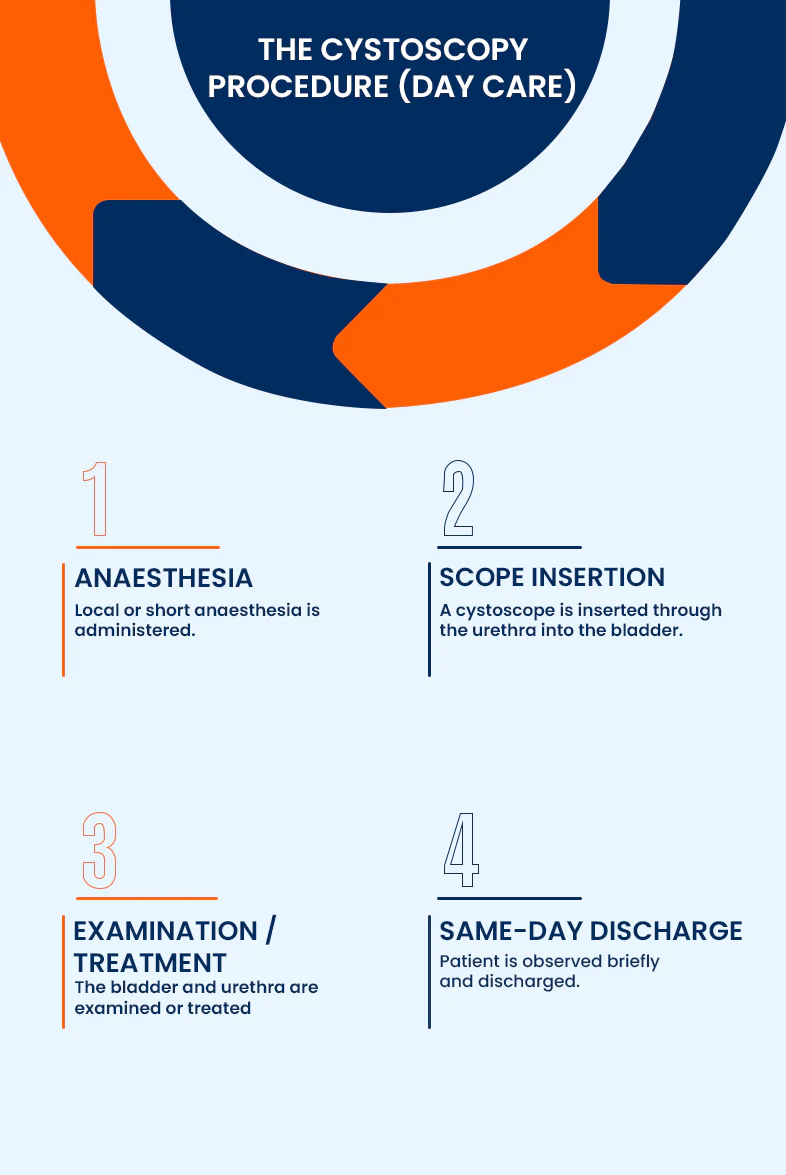
After you empty your bladder, anaesthesia is given - local numbing gel for flexible cystoscopy, or spinal/short general anaesthesia for rigid cystoscopy - so the examination is painless. The urinary opening is cleaned, and the lubricated scope is passed gently through the urethra.

Sterile saline fills the bladder so its walls unfold and every surface can be inspected on the monitor. The specialist systematically examines the urethra, prostate region (in men), bladder neck, walls and the openings of both ureters. Any biopsy or minor treatment such as stone crushing is completed in the same session.

The whole procedure takes 15-30 minutes. You rest in the day-care unit, pass urine once comfortably, and go home the same day. Mild burning during urination and slightly pink urine for a day or two are expected and settle quickly with fluids and prescribed medicines.

Recovery & aftercare

  • Drink 2.5-3 litres of water for the next two days to flush the bladder
  • Mild burning and pink-tinged urine for 24-48 hours are normal
  • Take the prescribed antibiotics and pain relief exactly as advised
  • Avoid strenuous activity, cycling and intercourse for three to five days
  • Report fever, inability to pass urine or persistent heavy blood in urine immediately
  • Collect biopsy reports at your free follow-up and discuss the treatment plan

Why Axten

Care that doesn't stop at the operating table

Every cystoscopy (day care) package includes your surgeon's fee, OT and anaesthesia charges, hospital stay, standard medicines and post-procedure follow-ups - quoted once, in writing, before you decide.

  1. Talk with our experts

    Share your reports on a free call. A specialist reviews your case the same day.

  2. Honest fixed quote

    Receive one all-inclusive package price in writing - before you commit to anything.

  3. Insurance & paperwork

    Our insurance desk secures cashless approval and completes every formality.

  4. Your procedure

    A senior specialist operates at a partner hospital near you, on your scheduled date.

  5. Recovery & follow-ups

    Free follow-up consultations and recovery monitoring until you are fully healed.

The Axten standard

Why patients choose Axten for cystoscopy (day care)

For cystoscopy (day care), Axten focuses on the parts patients usually find stressful: confirming the right specialist, explaining the procedure clearly, locking the package price in writing and keeping recovery follow-ups organised.

NABHstandard partner hospitals
100%written package quotes
24x7care helpline access

Senior surgeon review

Your case is reviewed for clinical fit before a date or package is suggested.
One written package

Surgeon, OT, anaesthesia, stay, standard medicines and follow-ups are itemised upfront.

Insurance handled early

Cashless eligibility, TPA paperwork and EMI options are checked before admission.

Coordinator-led recovery

A care coordinator keeps follow-ups, reports and recovery instructions organised.

FAQs about cystoscopy (day care)

Is cystoscopy painful?

No. Flexible cystoscopy uses anaesthetic gel and feels like mild pressure, while rigid cystoscopy is done under spinal or short general anaesthesia so you feel nothing. Afterwards, mild burning during urination for a day or two is common and settles with fluids and simple medicines prescribed at discharge.

Why do I need cystoscopy if my ultrasound was normal?

Ultrasound can miss small bladder tumours, flat abnormalities, early stones and urethral narrowing. Cystoscopy inspects the entire bladder lining directly in high definition, making it the gold-standard test for blood in urine and recurrent infections. A normal scan with ongoing symptoms is precisely when cystoscopy adds the most value.

How should I prepare for a day-care cystoscopy?

You will have a urine test beforehand to rule out infection and basic blood tests for anaesthesia fitness. Fast for about six hours if spinal or general anaesthesia is planned. Take your regular medicines as advised, inform us about blood thinners, and arrange someone to accompany you home the same day.

Is blood in urine after cystoscopy normal?

Slightly pink urine and mild burning for 24-48 hours are expected, especially after biopsy or stone treatment, and clear quickly with good hydration. However, bright red urine with clots, inability to pass urine, or fever with chills is not normal - contact Axten immediately on 8156-92-92-92 if these occur.

Can treatment be done during the same cystoscopy?

Often, yes. Small bladder stones can be fragmented and removed, small polyps resected, biopsies taken and a narrow urethra dilated in the same sitting, saving you a second anaesthesia and admission. Any add-on procedure and its cost are explained and consented before you enter the theatre - zero surprise billing.

How soon will I get my biopsy report?

Histopathology reports are typically ready in four to seven working days. Your dedicated care coordinator informs you as soon as the report arrives and schedules your free follow-up, where the specialist explains the findings in plain language and outlines the next steps, if any treatment is required at all.

Is cystoscopy safe for women with recurrent UTIs?

Yes - it is one of the most useful tests in recurrent urinary infection. Performed after the active infection is treated, cystoscopy checks for hidden causes such as stones, diverticula or urethral narrowing. Identifying and correcting these often ends the frustrating cycle of repeated antibiotics and recurring symptoms.

Ready to discuss cystoscopy (day care)?

Free specialist consultation and an honest all-inclusive quote - no obligation.