Advanced Breast Cancer Surgery

AdvancedSpecialist surgeons onlyCashless insuranceFree follow-ups
Breast cancer surgery consultation
Breast Cancer Surgery - specialist-led treatment at Axten

Breast cancer occurs when cells in the breast begin to grow abnormally, usually forming a lump. It is the most common cancer among Indian women - and also one of the most treatable, especially when found early. A breast lump is not a reason to panic: most lumps are benign, and even confirmed cancers detected early have excellent cure rates with modern treatment.

Surgery is the cornerstone of breast cancer treatment. Today's operations are very different from the disfiguring surgeries of the past. Breast-conserving surgery can remove the tumour while preserving the breast, and when complete removal is needed, reconstruction can restore shape and confidence - often in the same operation.

At Axten Hospitals, breast cancer surgery is performed only by specialist surgical oncologists, supported by a full tumour board of medical and radiation oncologists. Your treatment plan, timeline and honest all-inclusive surgery price are explained clearly at the start, with cashless insurance, 0% EMI and a dedicated care coordinator by your side - and zero surprise billing, always.

Honest all-inclusive price₹1,50,000 - ₹3,50,000 (all-inclusive, varies by type of surgery, reconstruction & city)See full cost breakdown

Consult for Breast Cancer Surgery

Share your details - a care coordinator calls you back within minutes.

Country code +91 selected.

100% confidential · No spam · Honest all-inclusive quotes

Symptoms of Breast Cancer

  • A painless lump or thickening in the breast or armpit
  • Change in the size, shape or contour of the breast
  • Dimpling, puckering or 'orange-peel' texture of the breast skin
  • Nipple turning inward, or discharge (especially blood-stained) from the nipple
  • Redness, scaling or a persistent rash on the nipple or breast skin
  • Swelling of part or all of the breast, even without a distinct lump

Risks of delaying treatment

  • A small, curable tumour can grow larger and involve the skin, muscle or armpit lymph nodes
  • Cancer may spread to other organs, changing the goal of treatment from cure to control
  • Larger tumours may rule out breast-conserving surgery, making mastectomy unavoidable
  • Treatment for advanced disease is longer, harder on the body and more expensive than early treatment

How is breast cancer diagnosed?

Diagnosis begins with a clinical breast examination, followed by imaging - usually a mammogram and breast ultrasound, and in selected cases an MRI. If a suspicious area is found, a core needle biopsy is done to confirm whether it is cancer and to study its receptor pattern (ER, PR and HER2), which guides the entire treatment plan.

Once cancer is confirmed, staging tests such as a chest X-ray, ultrasound of the abdomen or a PET-CT scan check whether the disease has spread. At Axten, your case is discussed in a multidisciplinary tumour board so that surgery, chemotherapy and radiation are sequenced correctly for the best possible outcome - and every report is explained to you in simple, honest language.

Benefits of advanced treatment

  • Breast-conserving options preserve the breast in a large number of patients
  • Sentinel node techniques reduce arm swelling by removing only necessary lymph nodes
  • Oncoplastic and reconstructive techniques restore natural breast shape and confidence
  • Complete tumour removal by specialist surgical oncologists improves long-term cure rates
  • Shorter hospital stay and quicker return to family and work
  • One honest all-inclusive package covering surgery, stay, implants and pathology

Types of breast cancer surgery

Non-surgical options

  • Neoadjuvant chemotherapy - medicines given before surgery to shrink the tumour and sometimes allow breast conservation.
  • Hormone (endocrine) therapy - tablets that block hormones feeding hormone-receptor-positive cancers.
  • Targeted therapy - drugs such as anti-HER2 agents that attack specific features of the cancer cell.
  • Radiation therapy - precisely focused radiation given after surgery to reduce the chance of recurrence.

Surgical & procedural options

  • Breast-conserving surgery (lumpectomy) - removal of the tumour with a safe margin while preserving the rest of the breast.
  • Simple mastectomy - removal of the entire breast when conservation is not safe or not preferred.
  • Modified radical mastectomy - removal of the breast along with the armpit lymph nodes when they are involved.
  • Sentinel lymph node biopsy - testing the first draining lymph node so healthy nodes can be left untouched.
  • Oncoplastic and reconstructive surgery - reshaping the breast or rebuilding it with implants or the body's own tissue, often in the same sitting.
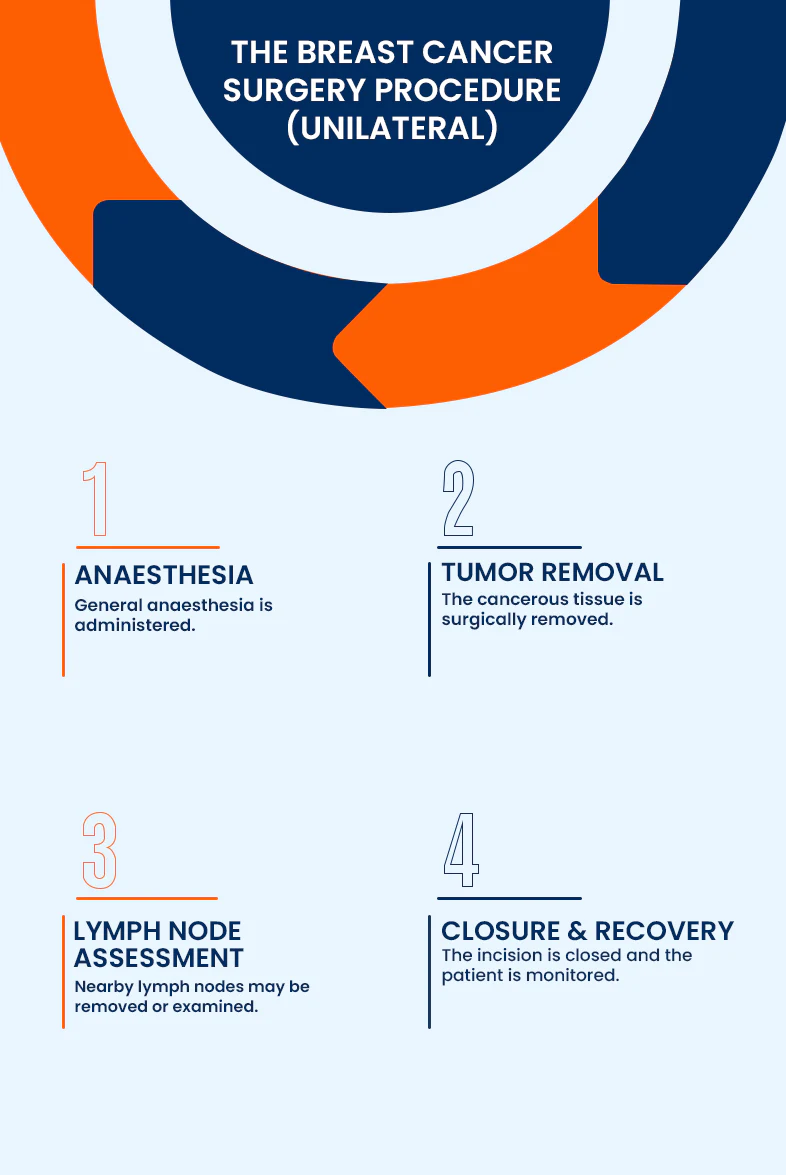
Unilateral breast cancer surgery procedure overview
How breast cancer surgery is performed

How the procedure is performed

Breast cancer surgery is performed under general anaesthesia, so you are completely asleep and feel nothing. Depending on the plan finalised with you, the surgeon either removes the lump with a healthy margin of tissue (breast-conserving surgery) or removes the whole breast (mastectomy). The armpit lymph nodes are assessed with a sentinel node biopsy or removed if they are involved.

The operation typically takes one and a half to three hours, longer if reconstruction is done in the same sitting. All removed tissue is sent for detailed pathology, which confirms that the cancer has been fully removed and fine-tunes the plan for any further treatment such as radiation, chemotherapy or hormone tablets.

Most patients stay in hospital for one to three days. A small drain tube may be placed near the wound for a few days to prevent fluid collection; it is painless and removed at review. Before discharge, your care coordinator books your follow-up visits - which are free at Axten - and arranges your pathology review with the oncology team.

Recovery & aftercare

  • Begin gentle shoulder and arm exercises from day one as taught by the physiotherapist - they prevent stiffness
  • Keep the dressing clean and dry; drains, if placed, are usually removed within 5-10 days
  • Most women resume light household activity within a week and office work in 2-3 weeks
  • Avoid lifting heavy weights with the operated-side arm for about 4-6 weeks
  • Attend your free follow-up visits so the team can review your pathology report and plan further treatment
  • Emotional ups and downs are normal - counselling and support are available whenever you need them

Why Axten

Care that doesn't stop at the operating table

Every breast cancer surgery package includes your surgeon's fee, OT and anaesthesia charges, hospital stay, standard medicines and post-procedure follow-ups - quoted once, in writing, before you decide.

  1. Talk with our experts

    Share your reports on a free call. A specialist reviews your case the same day.

  2. Honest fixed quote

    Receive one all-inclusive package price in writing - before you commit to anything.

  3. Insurance & paperwork

    Our insurance desk secures cashless approval and completes every formality.

  4. Your procedure

    A senior specialist operates at a partner hospital near you, on your scheduled date.

  5. Recovery & follow-ups

    Free follow-up consultations and recovery monitoring until you are fully healed.

The Axten standard

Why patients choose Axten for breast cancer surgery

For breast cancer surgery, Axten focuses on the parts patients usually find stressful: confirming the right specialist, explaining the procedure clearly, locking the package price in writing and keeping recovery follow-ups organised.

NABHstandard partner hospitals
100%written package quotes
24x7care helpline access

Senior surgeon review

Your case is reviewed for clinical fit before a date or package is suggested.

One written package

Surgeon, OT, anaesthesia, stay, standard medicines and follow-ups are itemised upfront.

Insurance handled early

Cashless eligibility, TPA paperwork and EMI options are checked before admission.

Coordinator-led recovery

A care coordinator keeps follow-ups, reports and recovery instructions organised.

FAQs about breast cancer surgery

Does every breast cancer patient need removal of the whole breast?

No. A large proportion of women diagnosed today can have breast-conserving surgery, where only the tumour and a safe margin are removed and the breast is preserved. Decades of research show that breast conservation followed by radiation gives the same survival as mastectomy in suitable patients. Your Axten surgical oncologist will tell you honestly whether conservation is safe in your case.

Is breast cancer curable?

Yes, very often - especially when detected early. Stage 1 and 2 breast cancers have excellent long-term cure rates with modern surgery, medicines and radiation. Even more advanced cancers respond well to today's combination treatments. The single most important thing you can do is act promptly once a lump or change is noticed, rather than waiting and worrying.

How long will I be in hospital after breast cancer surgery?

Most patients go home within one to three days. Breast-conserving surgery often needs just an overnight stay, while mastectomy with reconstruction may need two to three days. You will walk on the day of surgery itself. Your Axten package covers the full stay at one honest all-inclusive price, so a day more or less never becomes a billing surprise.

Will I need chemotherapy or radiation after surgery?

It depends on your tumour's stage, grade and receptor pattern, which the final pathology report reveals. Some women need chemotherapy, many need radiation after breast conservation, and most hormone-receptor-positive patients take hormone tablets for several years. Your case is reviewed by Axten's tumour board, and the complete plan - with costs - is explained before anything begins.

Can the breast be reconstructed after mastectomy?

Yes. Reconstruction can be done using an implant or your own tissue, either during the cancer operation itself or at a later date. It restores breast shape under clothing and greatly helps confidence and quality of life. Reconstruction does not increase the risk of the cancer returning and does not interfere with follow-up. Your surgeon will discuss the options best suited to you.

What does breast cancer surgery cost at Axten Hospitals?

Breast cancer surgery at Axten typically costs between ₹1,50,000 and ₹3,50,000 depending on the type of operation and whether reconstruction is included. This is an honest, all-inclusive package covering surgeon fees, anaesthesia, hospital stay, consumables and pathology - with zero surprise billing. Cashless insurance and 0% EMI are available. Call 8156-92-92-92 for a personalised estimate.

Will my arm swell after lymph node surgery?

Arm swelling (lymphoedema) has become much less common thanks to sentinel node biopsy, which removes only one or two nodes for testing instead of clearing the entire armpit. When full node removal is necessary, early physiotherapy and simple arm-care precautions keep the risk low. Axten's team teaches you these exercises before discharge and monitors your arm at every free follow-up visit.

How soon after diagnosis should breast cancer surgery be done?

Ideally within a few weeks of completing your staging tests. Breast cancer does not usually change overnight, so there is time to plan properly - but months of delay can allow the disease to progress. At Axten, your dedicated care coordinator fast-tracks your work-up, insurance approval and surgery date, so the interval between diagnosis and treatment stays as short as possible.

Ready to discuss breast cancer surgery?

Free specialist consultation and an honest all-inclusive quote - no obligation.