Advanced Knee Replacement Surgery

AdvancedSpecialist surgeons onlyCashless insuranceFree follow-ups
Knee replacement surgery consultation
Knee Replacement Surgery - specialist-led treatment at Axten

Knee arthritis is the gradual wearing away of the smooth cartilage that cushions the knee joint. As the cushion thins, bone begins to rub against bone, causing pain, stiffness, swelling and eventually a bent or bow-legged deformity. It is extremely common in India - especially in women over 55 - and is a leading reason why older adults give up walking, climbing stairs and sitting cross-legged.

Knee replacement surgery (total knee arthroplasty) resurfaces the damaged ends of the thigh and shin bones with precisely engineered metal and high-grade plastic components, recreating a smooth, pain-free joint. It is one of the most successful operations in modern medicine, with modern implants lasting 20-25 years in most patients.

At Axten Hospitals, knee replacements are performed only by specialist joint replacement surgeons using advanced alignment techniques and rapid-recovery protocols that have most patients walking the same or next day. You get one honest, all-inclusive package price - implant, surgery, stay and physiotherapy - with cashless insurance, 0% EMI, a dedicated care coordinator and zero surprise billing.

Honest all-inclusive price₹1,60,000 - ₹3,00,000 per knee (all-inclusive, varies by implant choice & city)See full cost breakdown

Consult for Knee Replacement Surgery

Share your details - a care coordinator calls you back within minutes.

Country code +91 selected.

100% confidential · No spam · Honest all-inclusive quotes

Symptoms of Knee Arthritis

  • Knee pain that worsens with walking, stairs or standing up from a chair
  • Morning stiffness or stiffness after sitting for a while
  • Swelling around the knee that keeps returning
  • A grinding or crunching sensation when the knee moves
  • Gradual bowing of the leg or visible change in its shape
  • Night pain that disturbs sleep
  • Reduced walking distance and increasing dependence on support

Risks of delaying treatment

  • Cartilage loss and deformity steadily worsen, making eventual surgery more complex
  • Weak thigh muscles and a stiff knee before surgery slow down recovery after it
  • Reduced mobility affects heart health, diabetes control, weight and overall independence
  • Constant pain and disturbed sleep take a real toll on mood and quality of life

How is knee arthritis diagnosed?

Diagnosis is straightforward: your surgeon examines the knee's alignment, movement and stability, and standing X-rays of the knee show how much cartilage has worn away and whether the leg has drifted into a deformity. In most patients, an examination and X-rays are all that is needed; an MRI is reserved for cases where ligament or soft-tissue problems are suspected.

Blood tests and a fitness evaluation by the physician and anaesthetist complete the work-up before surgery. Axten's team also assesses your home situation - stairs, toilets, flooring - so your recovery plan is practical from day one. Every finding, including whether you truly need surgery yet or can wait, is discussed with complete honesty.

Benefits of advanced treatment

  • Lasting relief from arthritis pain, including the night pain that disturbs sleep
  • Corrects bow-leg or knock-knee deformity and restores a confident, steady walk
  • Modern implants last 20-25 years in the majority of patients
  • Rapid-recovery protocols have most patients walking within 24 hours of surgery
  • Regain independence - stairs, temple visits, markets and travel become possible again
  • All-inclusive pricing covers implant, surgery, stay and physiotherapy with no hidden costs

Types of knee replacement surgery

Non-surgical options

  • Physiotherapy and quadriceps strengthening - the first line for early arthritis, improving support around the joint.
  • Weight reduction - every kilogram lost takes roughly four kilograms of load off the knees.
  • Pain-relieving medicines and topical gels - used judiciously for flare-ups under medical guidance.
  • Intra-articular injections - steroid or lubricant (viscosupplement) injections that can ease moderate arthritis for months.
  • Braces and walking aids - offloading braces and sticks that reduce pain during activity.

Surgical & procedural options

  • Total knee replacement - resurfacing of the entire knee joint, the standard operation for advanced arthritis.
  • Partial (unicompartmental) knee replacement - replacing only the worn compartment when damage is limited to one side, preserving natural bone and ligaments.
  • Bilateral knee replacement - both knees replaced in one admission (same sitting or staged) for patients with severe arthritis in both knees.
  • Revision knee replacement - exchange of an old or loosened implant with specialised components.
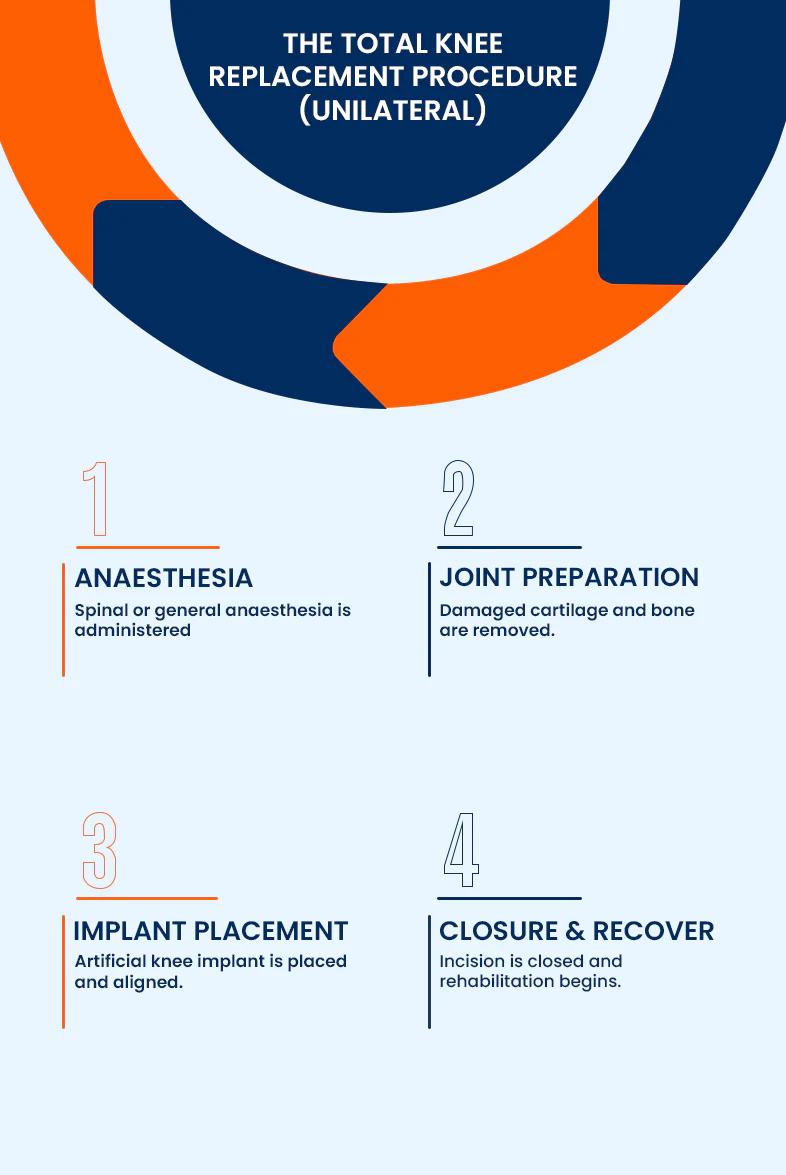
Unilateral total knee replacement procedure overview
How knee replacement surgery is performed

How the procedure is performed

Knee replacement is performed under spinal anaesthesia (you are numb from the waist down and comfortably sedated) or general anaesthesia. Through an incision at the front of the knee, the surgeon removes the thin, damaged surfaces of the thigh bone and shin bone - only a few millimetres of bone - and fixes precisely sized metal components in their place, with a medical-grade polyethylene insert between them acting as the new cartilage.

Advanced alignment instruments ensure the new joint matches your leg's natural axis, which is critical for a natural feel and long implant life. The operation takes about 60-90 minutes per knee. Local anaesthetic infiltration around the joint dramatically reduces pain after surgery.

Most patients stand and take their first steps with a walker within 24 hours, climb a few stairs by day two or three, and go home in three to five days with a structured physiotherapy plan. Your care coordinator arranges physiotherapy and your free follow-up visits, where your wound, walking and exercises are reviewed.

Recovery & aftercare

  • Walk with the walker from day one and follow the physiotherapy plan strictly - movement is medicine after knee replacement
  • Do the bending and straightening exercises several times daily to achieve a good range of motion in the first 6 weeks
  • Keep the wound clean and dry until it fully heals; report any redness, discharge or fever promptly
  • Use a raised toilet seat and avoid squatting or sitting cross-legged until your surgeon permits
  • Most patients walk unaided by 4-6 weeks and resume driving around 6-8 weeks
  • Attend your free follow-up visits so the team can track your progress with examination and X-rays

Why Axten

Care that doesn't stop at the operating table

Every knee replacement surgery package includes your surgeon's fee, OT and anaesthesia charges, hospital stay, standard medicines and post-procedure follow-ups - quoted once, in writing, before you decide.

  1. Talk with our experts

    Share your reports on a free call. A specialist reviews your case the same day.

  2. Honest fixed quote

    Receive one all-inclusive package price in writing - before you commit to anything.

  3. Insurance & paperwork

    Our insurance desk secures cashless approval and completes every formality.

  4. Your procedure

    A senior specialist operates at a partner hospital near you, on your scheduled date.

  5. Recovery & follow-ups

    Free follow-up consultations and recovery monitoring until you are fully healed.

The Axten standard

Why patients choose Axten for knee replacement surgery

For knee replacement surgery, Axten focuses on the parts patients usually find stressful: confirming the right specialist, explaining the procedure clearly, locking the package price in writing and keeping recovery follow-ups organised.

NABHstandard partner hospitals
100%written package quotes
24x7care helpline access

Senior surgeon review

Your case is reviewed for clinical fit before a date or package is suggested.
One written package

Surgeon, OT, anaesthesia, stay, standard medicines and follow-ups are itemised upfront.

Insurance handled early

Cashless eligibility, TPA paperwork and EMI options are checked before admission.

Coordinator-led recovery

A care coordinator keeps follow-ups, reports and recovery instructions organised.

FAQs about knee replacement surgery

At what age should knee replacement be done?

There is no fixed age - the right time is when arthritis pain limits your daily life despite medicines, physiotherapy and injections. Most patients are between 55 and 75, but younger patients with severe damage and older patients in good health are operated on routinely. Modern implants lasting 20-25 years mean surgeons no longer ask patients to simply endure pain for years.

How painful is knee replacement surgery?

Far less than most people fear. With spinal anaesthesia you feel nothing during surgery, and local anaesthetic infiltrated around the joint plus modern pain protocols keep discomfort well controlled afterwards. Most patients describe manageable soreness rather than severe pain, and walk within a day. Pain settles progressively over two to three weeks as you regain strength and confidence.

How long does a knee implant last?

Modern knee implants last 20 to 25 years in the large majority of patients, and many continue beyond that. Longevity depends on implant quality, surgical precision and alignment, body weight and activity habits. At Axten, only internationally proven implants are used, and their make and model are documented transparently in your records - part of our honest, zero-surprise approach.

Can both knees be replaced at the same time?

Yes, for medically fit patients with severe arthritis in both knees, simultaneous bilateral replacement is common - one anaesthesia, one admission and one combined rehabilitation. Patients with heart, lung or other significant conditions are usually advised staged surgery a few weeks or months apart. Your Axten surgeon and physician will jointly recommend the safer option for you.

Will I be able to sit cross-legged or climb stairs after knee replacement?

Stair climbing returns for virtually all patients, usually within weeks. Sitting cross-legged or squatting depends on the implant type and how well flexion recovers - many patients achieve enough bend for short periods of cross-legged sitting, but routine deep squatting is discouraged to protect the implant. Discuss your specific lifestyle needs with your surgeon so expectations are set honestly beforehand.

What does knee replacement cost at Axten Hospitals?

Knee replacement at Axten typically costs ₹1,60,000 to ₹3,00,000 per knee, depending mainly on the implant you choose. The price is honest and all-inclusive - implant, surgeon and anaesthesia fees, hospital stay, medicines and in-hospital physiotherapy - with zero surprise billing. Cashless insurance is accepted and 0% EMI plans are available. Call 8156-92-92-92 for an exact quote.

Is knee replacement covered by health insurance?

Yes. Knee replacement for arthritis is covered by almost all Indian health insurance policies, subject to the policy's waiting periods and room-rent limits. Axten's insurance desk checks your policy, obtains cashless pre-authorisation and manages all paperwork before admission, so you know exactly what is covered - and what, if anything, you pay - before surgery, not after.

What happens if I avoid surgery and manage with painkillers?

Painkillers mask symptoms but do not stop cartilage loss, and long-term daily use can harm the kidneys and stomach. Meanwhile the deformity, stiffness and muscle weakness slowly advance, making eventual surgery and recovery harder. If your arthritis is early, Axten's specialists will honestly recommend non-surgical care first; surgery is advised only when it is genuinely the better path.

Ready to discuss knee replacement surgery?

Free specialist consultation and an honest all-inclusive quote - no obligation.