Advanced C-Section Delivery

AdvancedSpecialist surgeons onlyCashless insuranceFree follow-ups
C-section delivery consultation and care
C-Section Delivery - specialist-led treatment at Axten

A caesarean section (C-section) is a surgical delivery in which the baby is born through a carefully planned incision in the mother's lower abdomen and uterus. It is recommended when a vaginal birth could put the mother or baby at risk - for example, in breech position, placenta praevia, foetal distress or obstructed labour. Performed by specialist obstetricians, a modern C-section is a safe, routine operation.

At Axten Hospitals, C-sections are performed using refined techniques - a low transverse (bikini-line) incision, spinal anaesthesia that keeps you awake to greet your baby, delayed cord clamping where appropriate, and immediate skin-to-skin contact. Advanced protocols such as ERAS (Enhanced Recovery After Surgery) mean earlier eating, earlier walking and a faster return home.

You receive one honest, all-inclusive package price covering the surgery, anaesthesia, room, medicines and newborn care - with zero surprise billing. Cashless insurance and 0% EMI make payment stress-free, and a dedicated care coordinator plus free post-surgery follow-ups support your recovery well after discharge.

Honest all-inclusive price₹55,000 - ₹1,10,000 (all-inclusive package, varies by room type & city)See full cost breakdown

Consult for C-Section Delivery

Share your details - a care coordinator calls you back within minutes.

Country code +91 selected.

100% confidential · No spam · Honest all-inclusive quotes

Symptoms of Caesarean Delivery

  • Baby in breech or transverse position near the due date
  • Labour that fails to progress despite strong contractions
  • Signs of foetal distress on heart-rate monitoring
  • Placenta lying low and covering the cervix (placenta praevia)
  • Severe pregnancy-induced hypertension or pre-eclampsia
  • Previous caesarean or uterine surgery with a risky scar
  • Twin or multiple pregnancy with unfavourable positioning

Risks of delaying treatment

  • Postponing an advised caesarean in foetal distress can cause oxygen deprivation and lasting harm to the baby
  • Labouring against placenta praevia may trigger sudden, life-threatening haemorrhage
  • Neglected obstructed labour risks uterine rupture, infection and injury to mother and child
  • Delaying surgery in severe pre-eclampsia can lead to seizures (eclampsia) and organ damage

How is caesarean delivery diagnosed?

The decision for a caesarean is made through antenatal assessment - ultrasound scans to check the baby's position, placental location and estimated weight, along with the mother's blood pressure, sugar levels and pelvic assessment. Some C-sections are planned weeks in advance; the reasons and alternatives are always discussed openly with the family.

During labour, continuous CTG monitoring may reveal foetal distress or non-progressing labour, prompting an emergency caesarean. Axten's labour suites are attached to fully equipped operation theatres, so the transition from labour room to a safe surgical delivery takes only minutes when required.

Benefits of advanced treatment

  • Planned, controlled delivery when vaginal birth would be unsafe
  • Spinal anaesthesia lets you stay awake and see your baby immediately
  • Bikini-line incision heals into a thin, discreet scar
  • Enhanced recovery protocols enable walking and eating within hours
  • Continuous monitoring protects both mother and baby throughout surgery
  • Immediate access to NICU support for premature or vulnerable newborns

Types of c-section delivery

Surgical & procedural options

  • Elective (planned) C-section - scheduled in advance for known medical indications such as placenta praevia or breech position.
  • Emergency C-section - performed urgently during labour when the mother's or baby's condition demands immediate delivery.
  • Lower segment caesarean section (LSCS) - the standard technique using a horizontal cut in the lower uterus, giving the strongest scar.
  • Gentle (family-centred) caesarean - a standard LSCS with a calm theatre environment, clear drape option and immediate skin-to-skin contact.
Caesarean section delivery procedure overview
How c-section delivery is performed

How the procedure is performed

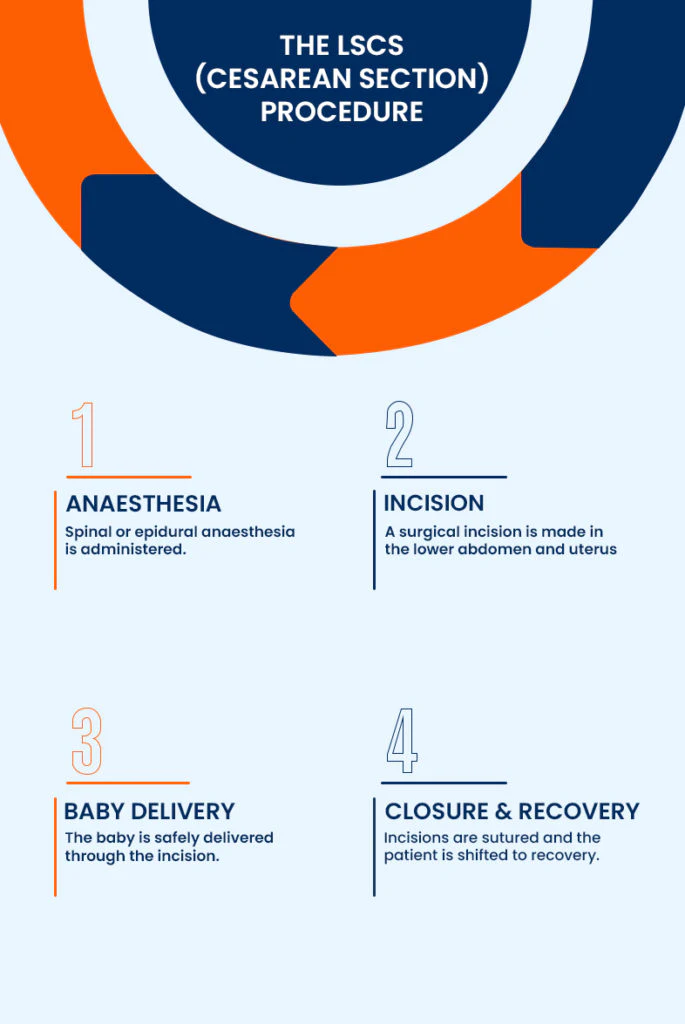
After admission and pre-operative checks, spinal anaesthesia is given - a single injection in the lower back that numbs you from the waist down while you remain fully awake. A urinary catheter is placed and the abdomen is cleaned and draped. General anaesthesia is reserved for rare emergencies.

The obstetrician makes a 10-12 cm horizontal incision just above the pubic hairline, gently opens the layers of the abdomen and uterus, and delivers the baby - usually within the first 5-10 minutes. You may feel pressure but no pain. The cord is clamped, your baby is shown to you and, if stable, placed on your chest while the placenta is removed.

The uterus and abdominal layers are closed with dissolvable sutures, and the skin with a fine cosmetic stitch. The entire operation takes about 45-60 minutes. You are observed in recovery for a couple of hours, begin sips of fluid soon after, and are helped to walk by the same evening or next morning.

Recovery & aftercare

  • Start walking within 12-24 hours to prevent clots and speed bowel recovery
  • Take prescribed painkillers on schedule - good pain control helps you breastfeed and move comfortably
  • Keep the incision clean and dry; report redness, discharge or fever promptly
  • Support the wound with a pillow while coughing, laughing or feeding
  • Avoid heavy lifting, stairs in excess and driving for about six weeks
  • Attend free Axten follow-ups for wound review, suture check and contraception advice

Why Axten

Care that doesn't stop at the operating table

Every c-section delivery package includes your surgeon's fee, OT and anaesthesia charges, hospital stay, standard medicines and post-procedure follow-ups - quoted once, in writing, before you decide.

  1. Talk with our experts

    Share your reports on a free call. A specialist reviews your case the same day.

  2. Honest fixed quote

    Receive one all-inclusive package price in writing - before you commit to anything.

  3. Insurance & paperwork

    Our insurance desk secures cashless approval and completes every formality.

  4. Your procedure

    A senior specialist operates at a partner hospital near you, on your scheduled date.

  5. Recovery & follow-ups

    Free follow-up consultations and recovery monitoring until you are fully healed.

The Axten standard

Why patients choose Axten for c-section delivery

For c-section delivery, Axten focuses on the parts patients usually find stressful: confirming the right specialist, explaining the procedure clearly, locking the package price in writing and keeping recovery follow-ups organised.

NABHstandard partner hospitals
100%written package quotes
24x7care helpline access

Senior surgeon review

Your case is reviewed for clinical fit before a date or package is suggested.

One written package

Surgeon, OT, anaesthesia, stay, standard medicines and follow-ups are itemised upfront.

Insurance handled early

Cashless eligibility, TPA paperwork and EMI options are checked before admission.

Coordinator-led recovery

A care coordinator keeps follow-ups, reports and recovery instructions organised.

FAQs about c-section delivery

Will I be awake during my C-section?

Yes, in most cases. Spinal anaesthesia numbs you from the waist down while you stay fully conscious, so you can hear your baby's first cry and have skin-to-skin contact in the theatre. General anaesthesia is used only in rare emergencies where every minute counts or when spinal anaesthesia is unsuitable.

How painful is recovery after a caesarean?

Modern multimodal pain control - a combination of spinal medication, regular tablets and local anaesthetic techniques - keeps most mothers comfortable. Discomfort is worst in the first two to three days and improves steadily. Most women walk within a day, manage stairs within a week and feel largely normal by six weeks.

How long is the hospital stay after a C-section?

Typically three to four days. With Axten's enhanced recovery protocol you start fluids within hours, eat normal food by the next day and walk early, all of which shorten the stay. Discharge happens once your pain is controlled, the wound looks healthy and feeding is well established, with free follow-ups afterwards.

Can I have a normal delivery after a previous C-section?

Often, yes. This is called VBAC (vaginal birth after caesarean) and succeeds in roughly 60-75% of carefully selected mothers. Suitability depends on the reason for the earlier caesarean, the type of uterine scar and the current pregnancy. Our specialists assess each case individually and monitor VBAC labours closely.

What will my C-section scar look like?

The incision is a thin horizontal line about 10-12 cm long, placed just above the pubic hairline so it sits below most underwear and swimwear lines. Cosmetic closure techniques and dissolvable sutures help it fade to a faint pale line over 6-12 months in most women.

Is the C-section package price really all-inclusive?

Yes. Your written Axten quote covers surgeon and anaesthetist fees, theatre charges, room stay, medicines, consumables, newborn examination and routine baby care. There is zero surprise billing - any change in clinical plan is discussed with you first. Cashless insurance and 0% EMI are available; call 8156-92-92-92 to confirm coverage.

How soon can I plan my next pregnancy after a caesarean?

Doctors generally advise an interval of at least 18-24 months before conceiving again. This allows the uterine scar to gain full strength and lowers the risk of scar-related complications in the next pregnancy. Discuss contraception options at your free follow-up visit so the gap is comfortably planned.

Ready to discuss c-section delivery?

Free specialist consultation and an honest all-inclusive quote - no obligation.