TURP / Laser Prostate Surgery for Enlarged Prostate (BPH)

TURP/LaserSpecialist surgeons onlyCashless insuranceFree follow-ups
Prostate surgery consultation and evaluation
Prostate Surgery - specialist-led treatment at Axten

The prostate is a small gland below the bladder that surrounds the urine passage. From middle age onwards it commonly enlarges - a benign (non-cancerous) condition called BPH, or benign prostatic hyperplasia. As the gland grows, it squeezes the urinary passage, causing a weak stream, straining, frequent night-time urination and the frustrating feeling that the bladder never empties completely. More than half of men over 60 have some degree of BPH.

When medicines stop helping, or complications like urine retention, recurrent infections, bladder stones or kidney pressure develop, surgery gives lasting relief. Modern TURP and laser procedures (such as HoLEP and ThuLEP) are performed entirely through the urinary passage - no cuts on the abdomen - removing the obstructing inner portion of the prostate so urine flows freely again, usually within days.

At Axten Hospitals, prostate surgery is performed only by senior specialist urologists using modern bipolar and laser technology. You receive one honest, all-inclusive package price with zero surprise billing, cashless insurance processing, 0% EMI options, a dedicated care coordinator and free post-surgery follow-ups until your urine flow and recovery are fully confirmed.

Honest all-inclusive price₹80,000 - ₹1,60,000 (all-inclusive; varies by prostate size, technique, stay & city)See full cost breakdown

Consult for Prostate Surgery

Share your details - a care coordinator calls you back within minutes.

Country code +91 selected.

100% confidential · No spam · Honest all-inclusive quotes

Symptoms of Enlarged Prostate (BPH)

  • Weak or interrupted urine stream, with straining to start
  • Waking two or more times at night to pass urine
  • Frequent urination and sudden, hard-to-control urgency
  • Feeling the bladder is not completely empty
  • Dribbling at the end of urination
  • Occasional blood in urine or repeated urinary infections
  • Sudden complete inability to pass urine (acute retention - an emergency)

Risks of delaying treatment

  • Sudden painful retention of urine can strike anytime, needing emergency catheterisation
  • Chronic obstruction thickens and weakens the bladder, sometimes irreversibly
  • Back-pressure on the kidneys can cause silent, permanent kidney damage
  • Stagnant urine leads to repeated infections and bladder stones, complicating eventual surgery

How is enlarged prostate (bph) diagnosed?

Evaluation starts with a symptom questionnaire (IPSS score), a physical examination including digital rectal examination of the prostate, and urine tests. An ultrasound measures prostate size and checks how much urine remains in the bladder after voiding, while a uroflowmetry test objectively records how weak the stream has become.

A PSA blood test is done to screen for prostate cancer, since BPH and cancer can coexist; kidney function tests check whether back-pressure has affected the kidneys. If PSA is raised or the examination is suspicious, an MRI or biopsy is advised first - Axten urologists always rule out cancer before planning BPH surgery.

Benefits of turp/laser treatment

  • No cuts or scars - the entire surgery is done through the urinary passage
  • Strong, free urine flow typically returns within days of catheter removal
  • Night-time waking, urgency and straining improve dramatically
  • Laser techniques mean minimal bleeding, even for very large prostates
  • Short hospital stay of one to two nights in most cases
  • Long-lasting relief, with a very low chance of needing repeat surgery

Types of prostate surgery

Non-surgical options

  • Alpha-blocker tablets - relax the prostate's muscle fibres to improve flow within days, though the effect lasts only while medicines continue
  • 5-alpha-reductase inhibitors - gradually shrink larger prostates over months and reduce the risk of retention
  • Lifestyle measures - evening fluid timing, reducing caffeine and alcohol, and bladder training ease milder symptoms

Surgical & procedural options

  • TURP (bipolar) - the time-tested gold standard; the obstructing prostate tissue is shaved away through the urine passage with saline-based bipolar energy
  • HoLEP / ThuLEP (laser enucleation) - laser peels out the entire inner gland with minimal bleeding, ideal for large prostates and patients on blood thinners
  • Laser vaporisation (PVP) - laser energy vaporises obstructing tissue, suited to small and medium glands
  • Open/robotic simple prostatectomy - reserved for extremely large glands or when bladder stones and diverticula need simultaneous repair
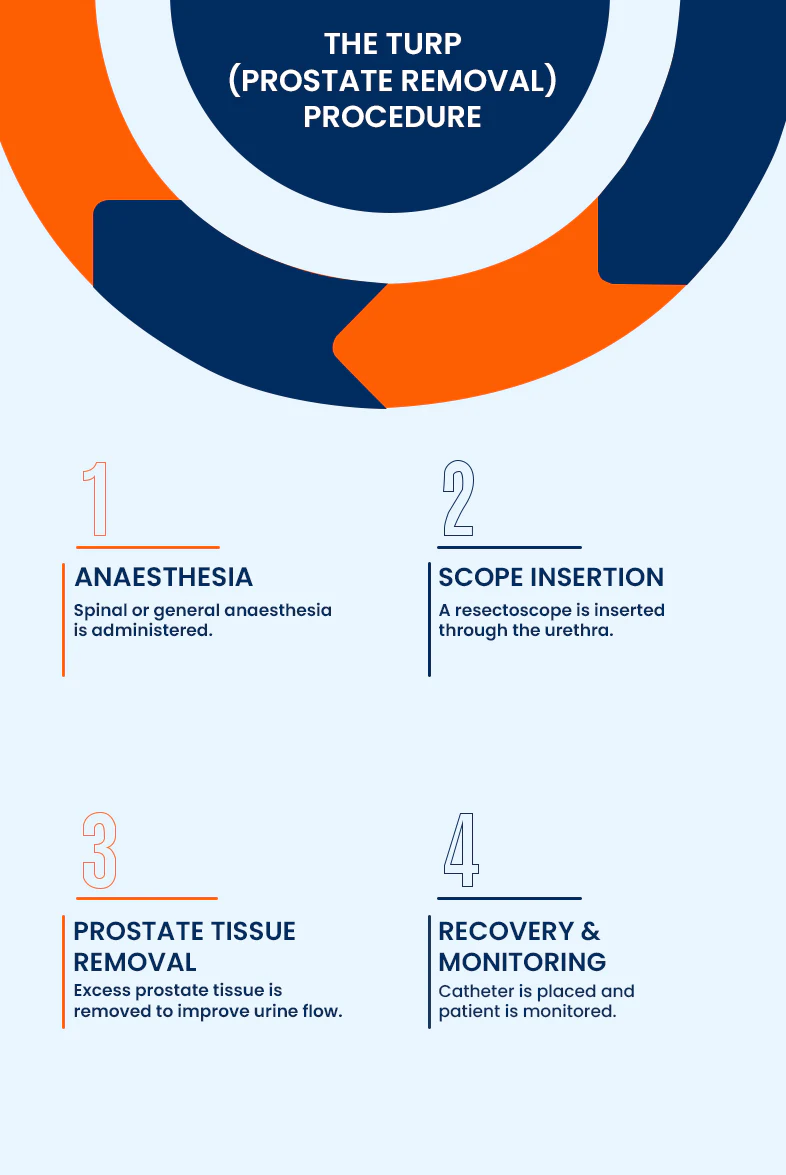
TURP prostate surgery procedure overview
How prostate surgery is performed

How the procedure is performed

Prostate surgery for BPH is done under spinal or general anaesthesia and takes roughly 60-90 minutes depending on gland size. A slim telescope is passed through the urinary passage - there is no external cut - giving the urologist a magnified view of the prostate from inside.

In TURP, the obstructing inner tissue is shaved away in slivers using a bipolar electric loop and the pieces are flushed out. In laser enucleation (HoLEP/ThuLEP), the laser separates the entire inner gland from its capsule, pushes it into the bladder, and a morcellator removes it - with tiny sealed blood vessels, bleeding is minimal even for very large prostates. Removed tissue is always sent for biopsy as a safety check.

A urinary catheter is placed for one to three days to keep the passage clear while it heals. Most patients walk the same evening, stay one to two nights, and go home passing urine comfortably after catheter removal.

Recovery & aftercare

  • Expect a catheter for one to three days and a hospital stay of one to two nights
  • Mild burning and pink-tinged urine for a week or two is normal - keep drinking plenty of water
  • Avoid straining, constipation, heavy lifting and cycling for three to four weeks
  • Resume gentle walks immediately and desk work within about a week
  • Urgency improves progressively; simple pelvic-floor exercises speed up control
  • Attend free follow-ups so flow, healing and the biopsy report can be reviewed

Why Axten

Care that doesn't stop at the operating table

Every prostate surgery package includes your surgeon's fee, OT and anaesthesia charges, hospital stay, standard medicines and post-procedure follow-ups - quoted once, in writing, before you decide.

  1. Talk with our experts

    Share your reports on a free call. A specialist reviews your case the same day.

  2. Honest fixed quote

    Receive one all-inclusive package price in writing - before you commit to anything.

  3. Insurance & paperwork

    Our insurance desk secures cashless approval and completes every formality.

  4. Your procedure

    A senior specialist operates at a partner hospital near you, on your scheduled date.

  5. Recovery & follow-ups

    Free follow-up consultations and recovery monitoring until you are fully healed.

The Axten standard

Why patients choose Axten for prostate surgery

For prostate surgery, Axten focuses on the parts patients usually find stressful: confirming the right specialist, explaining the procedure clearly, locking the package price in writing and keeping recovery follow-ups organised.

NABHstandard partner hospitals
100%written package quotes
24x7care helpline access

Senior surgeon review

Your case is reviewed for clinical fit before a date or package is suggested.
One written package

Surgeon, OT, anaesthesia, stay, standard medicines and follow-ups are itemised upfront.

Insurance handled early

Cashless eligibility, TPA paperwork and EMI options are checked before admission.

Coordinator-led recovery

A care coordinator keeps follow-ups, reports and recovery instructions organised.

FAQs about prostate surgery

When does an enlarged prostate actually need surgery?

Surgery is advised when symptoms remain troublesome despite medicines, or when complications appear - episodes of urine retention, recurrent infections, bladder stones, blood in urine, or kidney back-pressure. It is also reasonable when a man prefers a one-time lasting solution over lifelong tablets. Axten urologists always try appropriate medical therapy first and recommend surgery only when it genuinely offers you a better outcome.

What is the difference between TURP and laser prostate surgery?

Both are performed through the urinary passage with no external cut. TURP shaves the obstructing tissue with a bipolar electric loop and remains the time-tested standard for small and medium glands. Laser enucleation (HoLEP/ThuLEP) removes the entire inner gland with even less bleeding, making it ideal for large prostates and men on blood thinners. Results on urine flow are excellent with both.

Is prostate surgery for BPH the same as cancer surgery?

No. BPH surgery removes only the benign inner portion of the prostate to open the urinary channel; the outer capsule remains. Prostate cancer surgery (radical prostatectomy) removes the entire gland and is a different operation. Before any BPH procedure, Axten urologists check PSA and examination findings to rule out cancer, and all removed tissue is routinely sent for biopsy confirmation.

How long is recovery after TURP or laser prostate surgery?

Most men stay one to two nights in hospital and have the catheter removed within one to three days. Gentle daily activity resumes immediately, desk work in about a week. Mild burning and occasional pink urine settle over two to three weeks. Full healing of the internal surface takes about six weeks, during which heavy lifting, straining and cycling should be avoided.

Will prostate surgery affect my sexual function?

Erections are usually unaffected - the nerves responsible lie outside the operated area. The most common change is retrograde ejaculation, where semen passes backwards into the bladder during climax; it is harmless and does not reduce pleasure, though it matters for men still planning children. Your Axten urologist discusses this openly before surgery so you can decide with complete clarity.

Can BPH come back after surgery?

Recurrence is uncommon. After TURP, roughly 5-10% of men may need a repeat procedure over ten to fifteen years as remaining tissue slowly regrows. Laser enucleation (HoLEP/ThuLEP) removes the inner gland more completely, so regrowth is rarer still. Free follow-up visits at Axten include flow checks, letting us catch and manage any recurrence early - usually without another operation.

Is prostate surgery safe at 70 or 80 years of age?

Yes, with proper assessment. TURP and laser surgery are routinely and safely performed in men in their seventies and eighties, and laser techniques suit even those on blood thinners. Every Axten patient undergoes a thorough pre-anaesthesia check-up of heart, lungs, sugar and kidneys, and the anaesthesia plan is tailored accordingly. Age alone is almost never a reason to keep suffering.

What does the Axten prostate surgery package include?

One honest, all-inclusive price covering surgeon and anaesthetist fees, operation theatre and laser/bipolar equipment charges, room stay, medicines, consumables, catheter care, routine investigations and the biopsy of removed tissue - with zero surprise billing. Cashless insurance is processed by our desk, 0% EMI is available for self-paying patients, and all scheduled post-surgery follow-ups are free.

Ready to discuss prostate surgery?

Free specialist consultation and an honest all-inclusive quote - no obligation.