
Senior surgeon review
Your case is reviewed for clinical fit before a date or package is suggested.

An anal fistula is an abnormal tunnel that forms between the inside of the anal canal and the skin near the anus. It almost always develops after an anal abscess - a pus-filled infection of the small glands inside the anal canal - that drains but never fully heals, leaving behind a persistent infected tract.
A fistula does not heal on its own with medicines alone. Antibiotics may calm a flare-up temporarily, but the tunnel remains and infection keeps returning, causing recurrent swelling, pain and pus discharge that stains clothing and affects daily life. Fistulas are classified as simple or complex depending on how the tract runs in relation to the anal sphincter muscles.
Axten Hospitals treats anal fistulas with laser closure (FiLaC) and other sphincter-saving techniques performed only by specialist colorectal surgeons. You receive an all-inclusive Fixed Honest Price before admission, zero surprise billing, cashless insurance support, 0% EMI options and free follow-up visits until the tract heals completely.
Share your details - a care coordinator calls you back within minutes.
The surgeon first examines the area to locate the external opening and gently feels for the cord-like tract under the skin. A proctoscopy helps identify the internal opening inside the anal canal. Knowing the exact path of the tract is essential for choosing the safest treatment.
For complex, deep or recurrent fistulas, an MRI of the pelvis (MRI fistulogram) is the gold-standard investigation - it maps the tract in three dimensions and detects hidden branches or abscess pockets. At Axten, imaging is advised only when genuinely needed and is included transparently in your cost estimate.
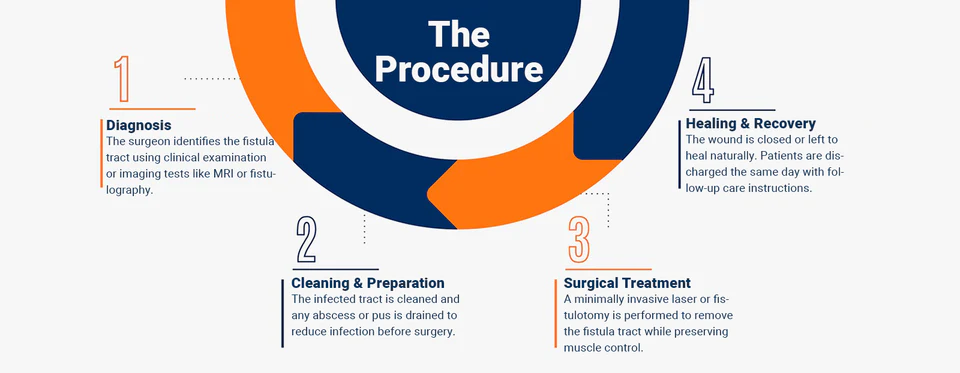
Laser fistula surgery is performed under short spinal or general anaesthesia. The surgeon first confirms the path of the tract and cleans it of infected tissue. A fine radial laser fibre is then passed through the tract, and controlled laser energy is delivered while the fibre is slowly withdrawn - shrinking and sealing the tunnel along its entire length.
The internal opening is closed and the small external opening is left to drain and heal naturally. Because the sphincter muscle is never cut, the risk of losing bowel control is minimal - a key advantage over traditional open fistula surgery.
The procedure takes about 30 to 45 minutes. Most patients go home the same day or after one night, walk comfortably immediately, and need only simple dressings. Your Axten care coordinator schedules free follow-ups to track healing until the tract closes fully.
Why Axten
Every fistula surgery package includes your surgeon's fee, OT and anaesthesia charges, hospital stay, standard medicines and post-procedure follow-ups - one Fixed Honest Price, in writing, before you decide.
Share your reports on a free call (8156-92-92-92). A specialist reviews your case the same day.
Receive one all-inclusive package price in writing - before you commit to anything.
Our insurance desk secures cashless approval and completes every formality.
A senior specialist operates at a partner hospital near you, on your scheduled date.
Free follow-up consultations and recovery monitoring until you are fully healed.
The Axten standard
For fistula surgery, Axten focuses on the parts patients usually find stressful: confirming the right specialist, explaining the procedure clearly, locking the package price in writing and keeping recovery follow-ups organised.
Your case is reviewed for clinical fit before a date or package is suggested.
Surgeon, OT, anaesthesia, stay, standard medicines and follow-ups are itemised upfront.
Cashless eligibility, TPA paperwork and EMI options are checked before admission.
A care coordinator keeps follow-ups, reports and recovery instructions organised.
Free specialist consultation and your Fixed Honest Price - no obligation.