
Health insights
Hernia in Women: Types, Symptoms and Operation
Hernia in women can be missed or mistaken for gynaecological pain. Learn the types, symptoms, causes and when surgery is needed.
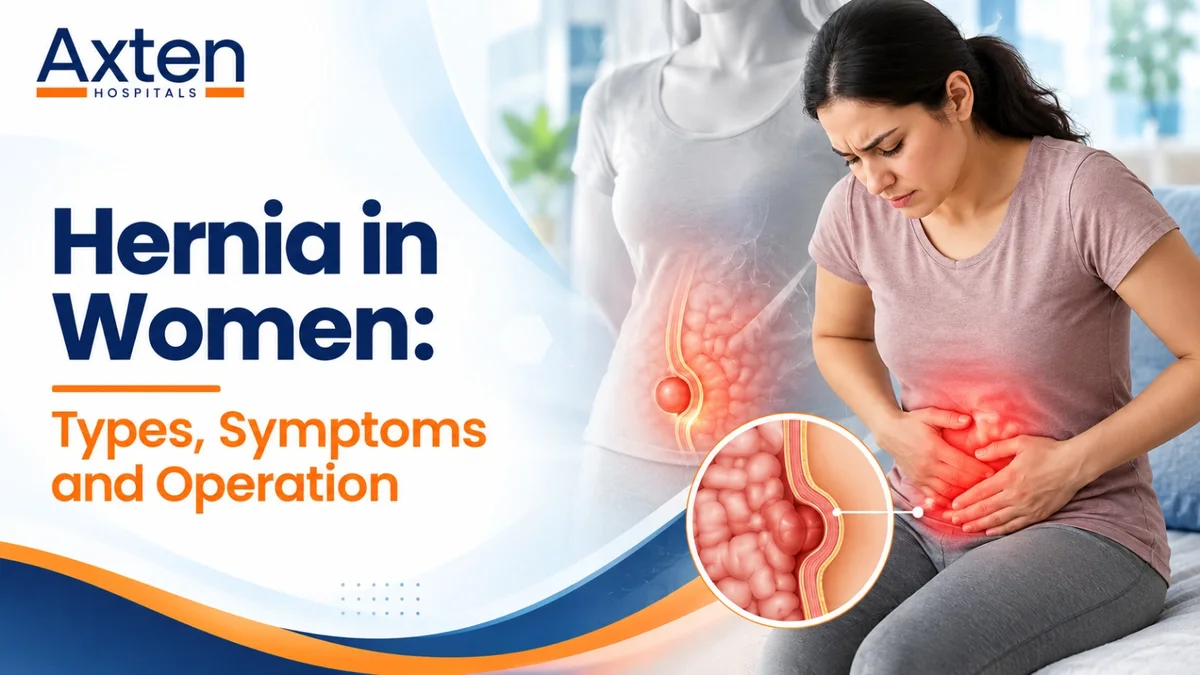
Hernia is often thought of as a man's problem, but women get hernias too. In women, they are easier to miss. The bulge may be small or not visible at all, and the pain is often blamed on periods, ovarian problems or a "weak stomach". A hernia that is found early is easier to treat.
What is a hernia?
A hernia is when a part of the gut or fatty tissue pushes through a weak spot in the muscle wall of the belly or groin. It does not heal on its own. The only way to repair it is surgery.
Types of hernia in women
-
Umbilical hernia: a bulge at or near the belly button. It is common after pregnancy, as the belly muscles are stretched.
-
Incisional hernia: a bulge at the site of an old surgical scar, such as after a C-section or hysterectomy
-
Femoral hernia: a small lump just below the groin crease. It is more common in women than in men, and has a higher risk of getting trapped.
-
Inguinal hernia: in the groin. Less common in women than in men, but it still occurs.
-
Epigastric hernia: a bulge in the middle of the upper belly
-
Hiatus hernia: part of the stomach slips up into the chest. It causes acidity and reflux and is managed differently.
Symptoms
-
A lump or bulge in the groin, belly button or belly, more visible when standing or coughing
-
Dull ache, pulling or heaviness in the groin or lower belly
-
Pain that gets worse with lifting, straining or coughing
-
A feeling of pressure near the scar or the navel
-
Groin or pelvic pain with no visible lump. Some women have a small hidden hernia that only a scan or laparoscopy can find.
Because the symptoms can seem like gynaecological pain, a good doctor will look at both possibilities.
Causes and risk factors
-
Pregnancy, especially more than one
-
Previous belly surgery, especially C-section
-
Being overweight
-
A long-lasting cough or constipation
-
Heavy lifting at work or at home
-
Weak muscles with age
-
Family history
Get help now: Go to the emergency room now if a hernia lump becomes hard, painful, red or purple, can't be pushed back, or comes with vomiting, a swollen belly, or no passing of gas or stool. A trapped hernia can cut off blood supply to the gut. Femoral hernias are especially risky.
How is it diagnosed?
A doctor examines you standing and lying down, and asks you to cough. An ultrasound is often enough. A CT scan or MRI can help when the hernia is small or hidden. Sometimes a keyhole (laparoscopic) look is used to confirm it.
Treatment: the hernia operation
Surgery repairs the weak spot, usually with a mesh for strength. It can be done in two ways:
-
Open repair: a cut over the hernia, the contents are pushed back, and the weak spot is closed and strengthened
-
Laparoscopic repair: a camera and small instruments through tiny cuts. It also lets the surgeon check the other side and look for hidden hernias. It usually means less pain and a quicker recovery.
Femoral hernias should be repaired soon. A small umbilical hernia without symptoms may be watched, but should be examined regularly.
What about pregnancy?
If you are pregnant, a small hernia without problems is usually watched until after delivery. If you plan more pregnancies, discuss the timing with your surgeon. Surgery during pregnancy is only for emergencies.
Recovery
-
Most women go home the same day or the next day
-
Walk from day one
-
Return to desk work in about 1 to 2 weeks
-
No heavy lifting for about 4 to 6 weeks
-
Avoid constipation, and treat a cough
-
Some swelling, bruising and discomfort at the site are expected
Call your doctor if you have fever, wound redness or discharge, severe pain or the lump returns.
Risks
Risks include infection, bleeding, fluid collection, ongoing pain and the hernia coming back. Mesh problems are uncommon. Your surgeon will explain these before you decide.
Common questions
Can hernia in women be treated without surgery? No. Exercise and medicines can't repair it. Small, painless ones may be watched, but the cure is surgery.
Is hernia in women different from men? The causes and types differ a little. Femoral hernias are more common and riskier in women, and they can be easy to miss.
Can I get pregnant after hernia surgery? Yes. Talk to your surgeon about the best timing.
Does a hernia cause period or pelvic pain? It can cause pain that feels similar, which is why women are sometimes misdiagnosed. A proper examination matters.
Have questions or want to see a specialist? For appointment and queries, call 8156929292. AXTEN HOSPITALS - HONEST SURGERY, HONEST CARE.