
Health insights
Kidney Stones: Symptoms, Causes and Treatment (RIRS, PCNL and More)
How kidney stones cause pain, when small stones pass on their own, and when RIRS, PCNL or other treatment is needed. A clear guide from Axten.
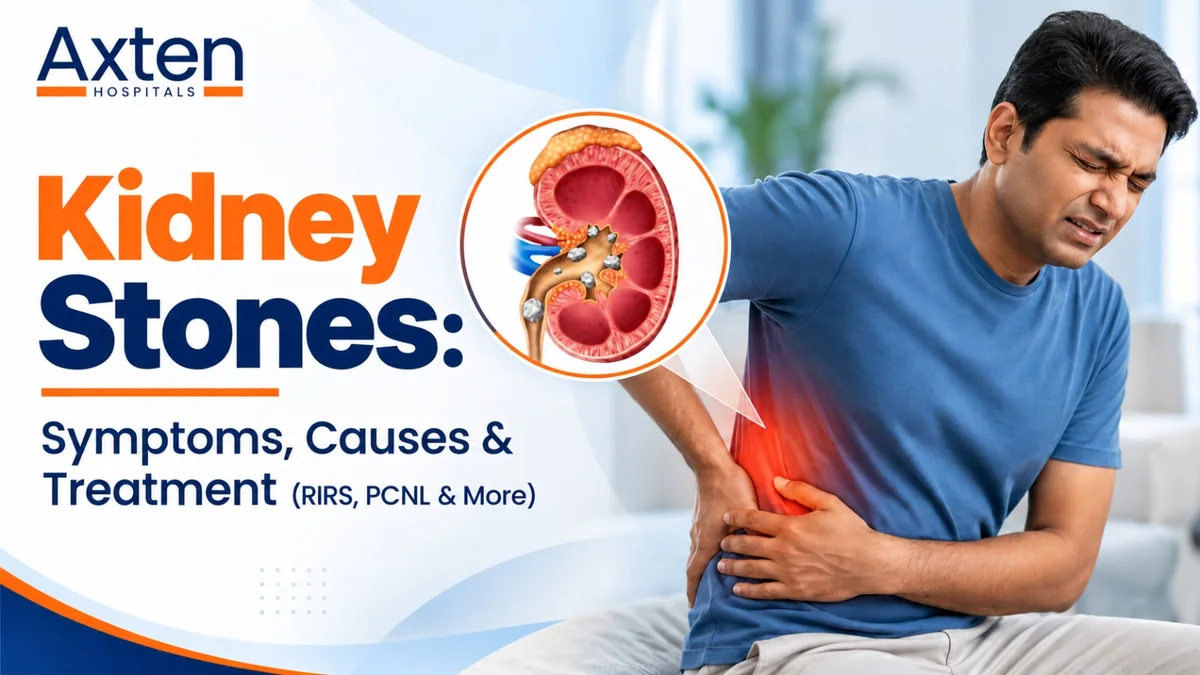
Kidney stone pain is known to be severe. Many stones pass by themselves, and the ones that don't can often be removed with no cut on the body.
What is a kidney stone?
Urine carries waste and minerals out of the body. When there is too much waste and too little water, tiny crystals can clump together and grow into a stone. It may stay in the kidney or move down the thin tube (ureter) that leads to the bladder. The main types are:
-
Calcium stones: the most common
-
Uric acid stones: more likely with high uric acid or gout
-
Struvite stones: linked to repeated urine infections
-
Cystine stones: rare, and run in families
Symptoms
A stone that sits still in the kidney may cause nothing. Pain starts when it moves or blocks the flow of urine.
-
Sudden, severe pain in the side or back, just under the ribs, often in waves
-
Pain that travels down to the lower belly and groin
-
Blood in the urine (pink, red or brown)
-
Burning while passing urine, or needing to go often
-
Nausea and vomiting
-
Restlessness, with no comfortable position
-
Cloudy or bad-smelling urine
Get help now: Go to the emergency room now if stone pain comes with fever or chills, you can't pass urine, you're vomiting so much that you can't keep fluids down, you have only one working kidney, or you are pregnant. A blocked, infected kidney can become dangerous quickly.
What causes kidney stones?
The most common cause is not drinking enough water. Other things add to the risk: hot weather and heavy sweating, too much salt, too much meat, fish and eggs, being overweight, high uric acid or gout, repeated urine infections, family history, and some medical conditions and medicines.
Calcium in normal food amounts doesn't cause stones. Cutting it out can actually raise the risk. Ask your doctor before taking calcium supplements.
How stones are diagnosed
Your doctor will ask about the pain and may advise a urine test, blood tests, an ultrasound and often a low-dose CT scan (CT KUB), which shows the stone's exact size and position. These decide the treatment.
Will my stone pass on its own?
It mostly depends on size and position. As a rough guide:
| Stone size | What usually happens |
|---|---|
| Under 5 mm | Often passes on its own within a few weeks |
| 5 to 10 mm | May pass, but many need help. The doctor will watch closely |
| Over 10 mm | Rarely passes alone. Usually needs a procedure |
While you wait, your doctor may give pain relief and a medicine that relaxes the ureter. Drink plenty of water. Don't take herbal "stone-dissolving" medicines without asking your doctor, as there is no proof they work.
Treatment when a stone needs removal
-
ESWL (shock wave lithotripsy): sound waves from outside the body break the stone into small pieces that you pass in urine. There is no cut, but it doesn't suit every stone.
-
Ureteroscopy (URS): a thin telescope goes up the urinary passage to the ureter, and a laser breaks the stone. No cut on the skin.
-
RIRS (retrograde intrarenal surgery): a very thin, flexible telescope goes into the kidney and a laser breaks the stone into tiny pieces. No cut on the body. It is commonly used for stones up to about 2 cm.
-
PCNL (percutaneous nephrolithotomy): for larger stones, usually over 2 cm, or stones that are hard to reach. The surgeon makes a cut of about 1 cm in the back, creates a narrow path into the kidney, and breaks and removes the stone through it.
-
DJ stent: a thin soft tube from the kidney to the bladder that keeps urine flowing while the ureter heals. It can cause burning, urgency or a little blood in urine. It must be removed on time, so keep the date your doctor gives you.
| RIRS | PCNL | |
|---|---|---|
| Cut on the body | None | One small cut (about 1 cm) in the back |
| Usually used for | Stones up to about 2 cm | Larger or complex stones |
| Hospital stay | Often 1 day | Often 2 to 3 days |
| Back to normal activity | A few days to a week | About 1 to 2 weeks |
These are general ranges. Your urologist will decide after seeing your scan.
Preventing new stones
After one stone, there's a fair chance of another unless a few habits change.
-
Drink enough water. For most people that means about 2.5 to 3 litres of fluid a day, more in hot weather. Pale yellow urine is a good sign. If you have a heart or kidney condition, ask your doctor first.
-
Cut down on salt: packaged snacks, pickles and papad.
-
Keep meat, fish and eggs in moderate portions.
-
Keep normal calcium in your diet (milk, curd, paneer).
-
If your stone was a calcium oxalate stone, your doctor may suggest limiting very high-oxalate foods such as large amounts of spinach, nuts and strong tea.
-
Keep a healthy weight and stay active.
-
If stones keep forming, ask your doctor about urine and blood tests to find the reason.
Common questions
How long does a stone take to pass? Small stones often pass in a few days to 4 weeks. If the pain doesn't settle, or you get a fever, see your doctor.
Can water dissolve a kidney stone? Not most stones. But water helps small stones pass and helps prevent new ones.
Is stone surgery painful? These procedures are done under anaesthesia, so you don't feel pain during them. Some discomfort afterwards is common and can be managed with medicines.
Can a stone come back? Yes. Drinking more water and adjusting your diet lower the chance.
Have questions or want to see a specialist? For appointment and queries, call 8156929292. AXTEN HOSPITALS - HONEST SURGERY, HONEST CARE.