
Health insights
Types of Kidney Stones and How They Look
Calcium, uric acid, struvite and cystine stones look and behave differently. See what each type looks like, what causes it and how it is treated.
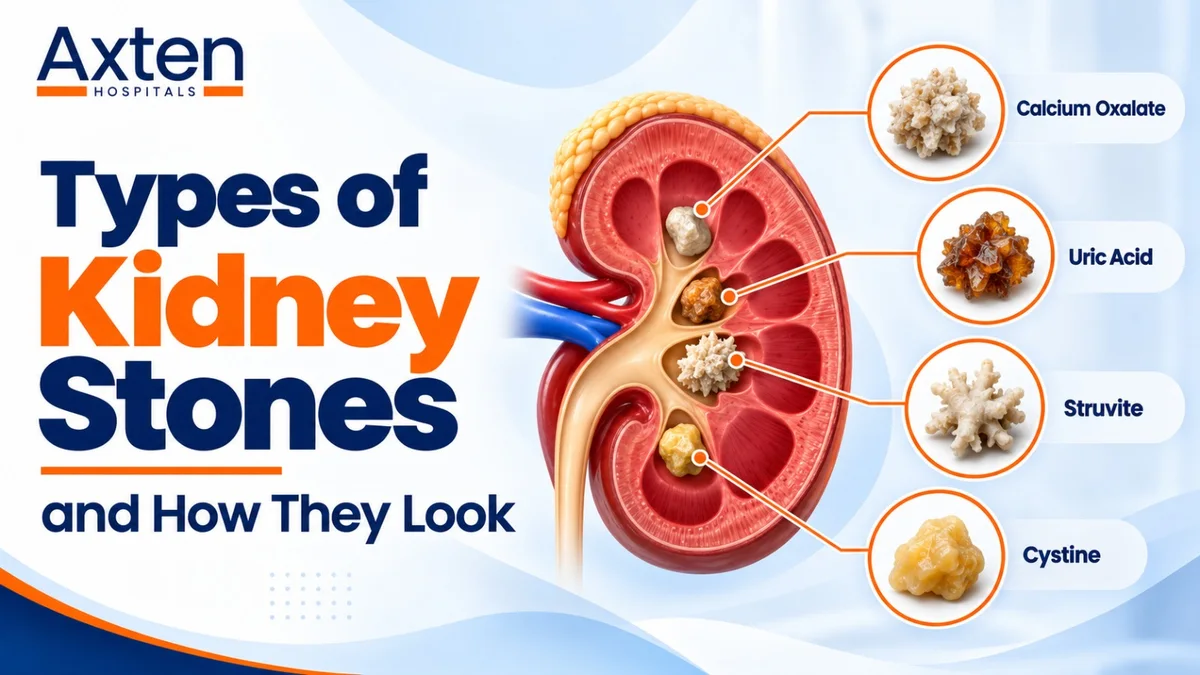
Not all kidney stones are the same. Some are tiny and smooth, some are rough and spiky, and a few grow large enough to fill the whole kidney. The type decides why the stone formed, whether it shows on an X-ray and how to stop the next one.
What does a kidney stone look like?
A kidney stone is a hard lump made of minerals and salts from the urine. Size, colour and shape vary a lot:
-
Size: from a grain of sand to a pea, and sometimes as big as a golf ball
-
Colour: white, yellow, brown, orange or almost black
-
Surface: smooth and round, or rough with sharp edges
-
Shape: round, oval, or branched like a deer's antlers (a staghorn stone)
A photo or a stone you've passed can give a hint, but it can't tell the exact type. Only a lab test of the stone can do that.
The main types of kidney stones
| Type | How it usually looks | Common cause | Shows on X-ray? |
|---|---|---|---|
| Calcium oxalate | Dark brown or black, hard, often rough or spiky | Low water intake, too much salt, high oxalate foods, too little calcium in the diet | Yes |
| Calcium phosphate | White to light brown, smooth or slightly rough | Alkaline urine, some metabolic and gland conditions | Yes |
| Uric acid | Yellow, orange or reddish-brown, smooth and hard | High uric acid, gout, acidic urine, a lot of meat | Often not visible |
| Struvite | White or yellowish-grey, soft and crumbly, can grow large | Repeated urine infections | Yes |
| Cystine | Yellow, waxy, like a crystal or honey-coloured | A rare condition that runs in families | Faintly |
Calcium stones
These make up most stones, about 8 in 10. Calcium oxalate is the most common. Calcium in your food is not the enemy. In fact, eating too little calcium can raise oxalate in the urine. What matters more is too little water, too much salt and too much animal protein.
Uric acid stones
These are more likely if you have gout, diabetes, are overweight or eat a lot of meat and fish. They form in acidic urine. Because they don't show well on a plain X-ray, a CT scan or ultrasound is often used. Some of them can be dissolved with medicine that makes the urine less acidic.
Struvite stones
These are linked to repeated urine infections, more often in women. They grow fast and can fill the kidney (staghorn stones). Treatment usually means removing the stone and clearing the infection, otherwise it comes back.
Cystine stones
These are rare and run in families. They tend to start young and keep returning, so they need long-term follow-up with a urologist.
Symptoms are similar in every type
-
Sudden, severe pain in the side or back that comes in waves
-
Pain that moves down to the lower belly and groin
-
Blood in the urine, or burning while passing it
-
Nausea and vomiting
-
Cloudy or bad-smelling urine
Get help now: Go to the emergency room now if stone pain comes with fever or chills, you can't pass urine, or you can't stop vomiting. A blocked and infected kidney can become dangerous quickly.
How the type is found
-
Urine tests for blood, infection and acidity
-
Blood tests for uric acid, calcium and kidney function
-
Ultrasound, X-ray or a CT scan to see the size and place of the stone
-
Stone analysis: if you pass a stone, strain your urine through a clean cloth or strainer, keep the stone and show it to your doctor. The lab can tell you what it is made of.
Treatment depends on size and place, more than type
Stones under about 5 mm often pass on their own with plenty of water and medicines for pain. Stones of 5 to 10 mm sometimes pass and sometimes need help. Larger stones, or stones that block the urine, usually need removal.
-
Lithotripsy (ESWL): shock waves break the stone from outside
-
RIRS: a thin telescope goes up through the urine passage and a laser breaks the stone, with no cut on the body
-
PCNL: a small cut in the back is used to remove large kidney stones
-
Ureteroscopy: for stones lower down in the ureter
Your urologist chooses the method after scans. No one method suits every stone.
How to stop the next stone
-
Drink enough water to pass about 2 to 2.5 litres of urine a day, which usually means 3 litres or more of fluids
-
Cut down on salt
-
Don't overdo meat, fish and eggs
-
Keep eating calcium-rich food like milk and curd, unless your doctor says otherwise
-
If you have uric acid stones, ask your doctor about diet and medicines
-
Treat urine infections early
Common questions
Can I tell the type of stone from a photo? Not reliably. Colour and shape give clues, but the exact type needs a lab test of the stone.
Which kidney stone is the most dangerous? Any stone that blocks urine or comes with infection is urgent. Struvite stones can grow large and damage the kidney if left alone.
Do all kidney stones need surgery? No. Many small stones pass by themselves. Surgery is for stones that are large, blocked, infected or won't pass.
Can stones come back? Yes. About half of people who have one stone get another within years, so water and diet changes matter.
Have questions or want to see a specialist? For appointment and queries, call 8156929292. AXTEN HOSPITALS - HONEST SURGERY, HONEST CARE.